
Enterprise AI Voice Agent Development: Build, Integrate & Deploy Voice Automation
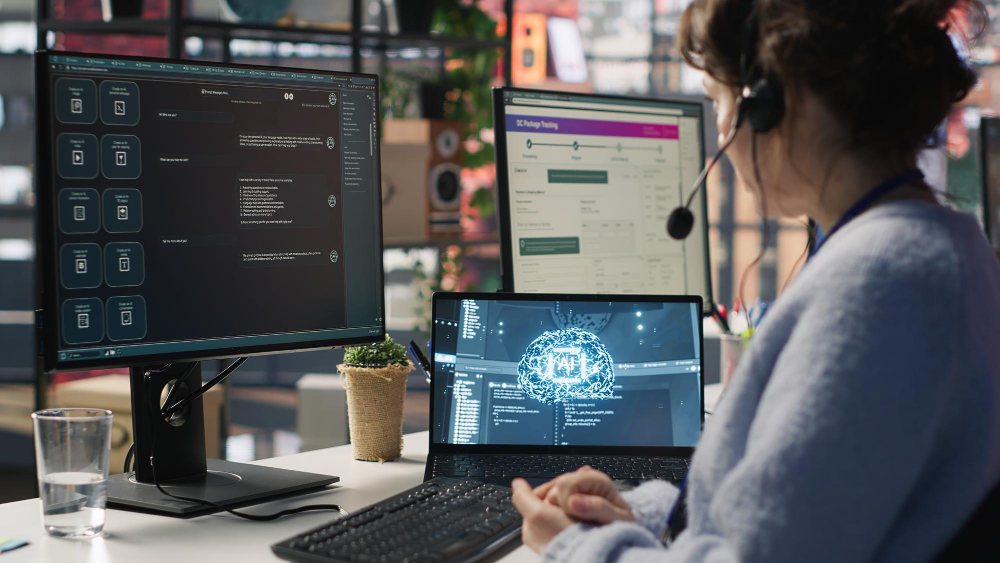
Enterprise customer communication is evolving beyond traditional call centers, manual call handling, and rule-based interactive voice response (IVR) systems. Businesses are increasingly adopting AI Voice Agents to handle customer inquiries, qualify leads, schedule appointments, process requests, and connect callers with the right resources.
However, implementing voice automation at enterprise scale requires more than adding a conversational AI interface to a phone system. Organizations need reliable speech processing, low-latency AI models, secure integrations, workflow orchestration, and clear escalation procedures to ensure that automated conversations lead to meaningful outcomes.
Enterprise AI Voice Agent development involves designing, building, integrating, testing, and deploying AI-powered voice systems that can understand spoken requests and perform authorized business tasks. Depending on the use case, these agents can connect with customer relationship management (CRM) platforms, enterprise resource planning (ERP) systems, scheduling software, databases, and contact center infrastructure.
For enterprises evaluating voice automation, understanding the development lifecycle helps clarify the technical requirements, implementation risks, and business decisions involved in moving from an initial concept to a production-ready solution.
What Is Enterprise AI Voice Agent Development?
Enterprise AI Voice Agent development is the process of building voice-based AI systems that communicate with customers or employees, interpret spoken requests, and execute defined tasks through connected applications and business workflows.
Unlike conventional IVR systems that primarily rely on fixed menus and predefined responses, AI Voice Agents can support more flexible, natural-language conversations. Depending on their architecture, they can interpret intent, retrieve information, call authorized tools, and manage multi-step interactions.
Common enterprise applications include:
- Customer support automation: Answering routine questions and retrieving relevant information.
- Appointment scheduling: Booking, rescheduling, and confirming appointments.
- Lead qualification: Collecting prospect information and routing qualified leads to sales teams.
- Customer follow-ups: Making reminders and follow-up calls through approved workflows.
- Reservation management: Handling booking inquiries for hotels and hospitality businesses.
- Financial service assistance: Supporting routine account inquiries and routing sensitive requests appropriately.
- Transportation operations: Assisting with bookings, dispatch inquiries, and service updates.
The goal is not to automate every conversation indiscriminately. It is to identify interactions where voice automation can improve availability, responsiveness, consistency, or operational efficiency while preserving appropriate human support.
How Enterprise AI Voice Agents Work
An enterprise AI Voice Agent typically combines speech technology, an AI reasoning component, business integrations, and telephony infrastructure.
A typical interaction follows this sequence:
- Call initiation: A customer calls the business or receives an authorized outbound call.
- Speech recognition: The system converts spoken input into text or another machine-readable representation.
- Intent interpretation: The AI determines what the caller is asking and identifies relevant context.
- Information retrieval: The agent accesses approved knowledge sources or retrieves authorized customer information.
- Tool execution: The agent invokes connected APIs or business systems to perform permitted actions.
- Response generation: The system generates a relevant response and converts it into speech.
- Validation and escalation: The system confirms important details and transfers the interaction to a human when necessary.
- Logging and reporting: Relevant interaction events and outcomes are recorded according to business policies.
The underlying architecture may use speech-to-text, text-to-speech, an LLM, a real-time speech model, or a combination of these technologies. The appropriate approach depends on latency requirements, conversation complexity, language needs, infrastructure, and cost.
A production system also needs safeguards for interruptions, unclear speech, failed integrations, unsupported requests, and unexpected responses.
The Enterprise AI Voice Agent Development Process
1. Discovery and Use-Case Identification
The first step is identifying which business conversations are suitable for automation.
Development teams should review current call volumes, common inquiries, repetitive tasks, escalation patterns, and operational bottlenecks. They should also establish the expected business outcomes and identify situations where human intervention remains essential.
For example, a healthcare organization might prioritize appointment reminders and scheduling, while an auto dealership might focus on service bookings and test-drive inquiries.
The discovery phase should define the agent’s responsibilities, supported conversation types, required data, risk boundaries, and success metrics.
Deliverable: A use-case assessment with prioritized workflows, requirements, risks, and measurable objectives.
2. Voice Agent Architecture and Technology Selection
Once the use case is defined, the development team designs the technical architecture.
Important components may include:
- Telephony and call-routing infrastructure.
- Speech recognition and speech generation.
- AI models for interpreting requests and generating responses.
- Conversation state and context management.
- Business workflow orchestration.
- API and enterprise system integrations.
- Authentication, authorization, and monitoring.
Technology selection should consider speech quality, latency, supported languages, reliability, scalability, and operating costs.
For enterprise environments, architecture decisions should also account for concurrency, call transfer, retry handling, auditability, and the ability to switch or update components without disrupting the entire system.
Deliverable: A solution architecture and technology plan aligned with operational requirements.
3. Conversation Design and Agent Configuration
A voice agent needs a clearly defined conversation strategy. Even capable AI models can produce poor experiences when instructions, boundaries, or escalation paths are unclear.
Conversation design establishes how the agent greets callers, identifies their needs, asks follow-up questions, confirms information, and completes tasks.
The development team should define:
- The agent’s role and supported tasks.
- Tone, language, and communication style.
- Required information for each workflow.
- Rules for ambiguous or incomplete requests.
- Confirmation steps before important actions.
- Conditions for transferring to a human.
- Responses for unsupported requests or system failures.
For example, an appointment-booking agent should confirm the requested service, check available slots through the scheduling system, and verify the selected time before completing the booking.
Deliverable: Conversation flows, agent instructions, business rules, and escalation scenarios.
4. Enterprise System Integration
Integration allows an AI Voice Agent to move beyond answering questions and complete useful business tasks.
Common integrations include CRM platforms, scheduling applications, ERP systems, customer databases, help desks, payment systems, and contact center software.
For instance, a sales voice agent may retrieve an authorized lead record, qualify a prospect, schedule a meeting, and update the CRM through approved APIs.
Integration design should address authentication, permissions, API limits, timeouts, retries, data validation, and error handling. The agent should not be able to execute actions simply because a caller requests them; the system must enforce business permissions independently.
Deliverable: Tested integrations with defined access controls and workflow validation.
5. Development and Workflow Automation
During development, engineers connect the selected voice technology to the conversation logic, business tools, and enterprise applications.
Depending on the use case, implementation may include inbound call handling, outbound calling workflows, appointment booking, lead qualification, customer support, or multi-step task automation.
Developers should design the system to handle interruptions, unclear answers, caller corrections, and incomplete information without losing the conversation context.
Important actions should use deterministic validation where appropriate. For example, the agent can interpret a caller’s request, but the scheduling application should independently verify availability before confirming an appointment.
Deliverable: A functional AI Voice Agent capable of executing the approved workflows.
6. Testing, Security, and Performance Evaluation
Before production deployment, the agent should be tested against realistic conversations and failure scenarios.
Testing should evaluate:
- Speech recognition accuracy across representative accents and environments.
- Response relevance and conversation quality.
- End-to-end task completion.
- API and integration reliability.
- Response latency and interruption handling.
- Authentication and data access controls.
- Resistance to prompt injection and unauthorized actions.
- Recovery from missing information, timeouts, and service failures.
- Appropriate human escalation.
Businesses should also test whether the agent communicates uncertainty appropriately and avoids inventing information when a connected system cannot provide an answer.
Useful metrics include successful task completion, call containment where appropriate, transfer rate, booking accuracy, response latency, caller satisfaction, and cost per completed interaction.
Deliverable: A test report documenting performance, identified risks, and production-readiness decisions.
7. Pilot Deployment and Production Launch
A controlled pilot allows the organization to evaluate the agent under real operating conditions before expanding its use.
The pilot may cover a limited call type, business location, customer segment, or operating period. Teams should compare results with the existing process and collect feedback from customers and employees.
Before launch, the organization should establish monitoring, incident response, call transfer procedures, access controls, and operational ownership.
Production deployment may involve integrating the agent with existing telephony infrastructure, configuring routing rules, training support teams, and preparing rollback procedures.
Deliverable: A production deployment with monitoring, support processes, and defined ownership.
8. Continuous Monitoring and Optimization
AI Voice Agents require ongoing evaluation after launch. Changes in customer behavior, model performance, knowledge sources, APIs, and business processes can affect the quality of interactions.
Ongoing optimization may include reviewing failed conversations, improving speech recognition, refining conversation instructions, updating knowledge sources, and reducing unnecessary API calls.
Organizations should also monitor operating costs, integration failures, escalation patterns, and customer feedback. Significant model or workflow changes should be tested before release.
Deliverable: A continuous improvement plan covering performance, reliability, maintenance, and business outcomes.
Key Features Every Enterprise AI Voice Agent Should Have
When evaluating enterprise AI Voice Agent development services, businesses should consider the following capabilities:
- Natural conversation handling: Understands caller intent and supports appropriate follow-up questions.
- Low-latency responses: Maintains a natural conversational flow.
- CRM and API integration: Retrieves authorized information and executes approved tasks.
- Workflow automation: Completes defined multi-step business processes.
- Human handoff: Transfers complex, sensitive, or unsupported requests to qualified employees.
- Security and access control: Protects customer information and restricts unauthorized actions.
- Analytics and monitoring: Tracks task completion, call outcomes, failures, and operational performance.
- Scalability: Supports expected call volumes and concurrency requirements.
- Multilingual support: Handles required languages and regional communication needs.
- Reliability and recovery: Manages failed integrations and unexpected conversation paths gracefully.
The right feature set depends on the intended application. Enterprises should prioritize capabilities that support their business workflows rather than selecting a platform based on feature count alone.
Enterprise AI Voice Agent Development Cost and Timeline
Development costs and delivery timelines vary according to conversation complexity, telephony infrastructure, integrations, AI model selection, security requirements, and expected call volume.
A limited proof of concept may be completed in a few weeks, while a production-grade enterprise solution involving several systems, extensive testing, and complex workflows may require several months or longer.
Major cost factors include:
- Voice and AI model usage.
- Telephony and communication charges.
- Custom software engineering.
- CRM, ERP, and API integrations.
- Data preparation and knowledge integration.
- Security, testing, and compliance requirements.
- Hosting, monitoring, and ongoing maintenance.
Businesses should distinguish initial development costs from recurring operational expenses. A useful financial evaluation considers cost per completed task, employee time saved, missed-call reduction, appointment conversion, customer experience, and the cost of human escalation.
Rather than assuming that voice automation will eliminate staffing needs, organizations should measure its actual impact on specific workflows.
Why Choose Virstack for Enterprise AI Voice Agent Development?
Virstack helps businesses explore software engineering and AI solutions aligned with their operational needs. Organizations evaluating voice automation should begin by identifying the conversations they want to improve, the systems the agent must access, and the outcomes they expect to achieve.
Depending on project scope, an implementation may involve voice workflow design, custom development, enterprise integration, testing, deployment, and ongoing optimization.
Virstack offers industry-focused AI Voice Agent solutions for:
- Healthcare — appointment scheduling and patient communication workflows.
- Fintech — customer inquiries and appropriate service routing.
- Hospitality — reservations and guest assistance.
- Auto Dealerships — service inquiries and test-drive bookings.
- Real Estate — lead qualification and property inquiry handling.
- Transportation — booking and dispatch-related communication.
The appropriate solution depends on business requirements, existing systems, customer expectations, and the level of automation that can be implemented safely.
Planning to deploy an enterprise AI Voice Agent? Start by identifying a high-volume workflow, defining measurable success criteria, and evaluating the integrations and safeguards required for production.
Frequently Asked Questions
What is enterprise AI Voice Agent development?
Enterprise AI Voice Agent development involves building voice-based AI systems that communicate with callers, interpret requests, retrieve authorized information, and execute defined business workflows through connected systems.
How long does it take to build an enterprise AI Voice Agent?
A focused proof of concept may take a few weeks. A production implementation may take several months or longer, depending on integrations, workflow complexity, testing, security requirements, and deployment constraints.
Can enterprise AI Voice Agents integrate with CRM and ERP systems?
Yes. They can connect to supported CRM, ERP, scheduling, database, and customer service systems through APIs and approved integration methods. Permissions, validation, and error handling should be implemented for each workflow.
Are AI Voice Agents suitable for regulated industries?
They can support regulated workflows when designed and validated against the applicable requirements. This may include access controls, data minimization, audit logs, retention policies, human oversight, and appropriate security assessments. Compliance should be verified for the specific implementation.
How do businesses measure AI Voice Agent performance?
Common metrics include successful task completion, call transfer rate, booking accuracy, response latency, caller satisfaction, system reliability, and cost per completed interaction. The most relevant KPIs depend on the business objective.
What is the difference between an AI Voice Agent and a traditional IVR system?
Traditional IVR systems generally rely on predefined menus and routing rules. AI Voice Agents can interpret natural-language requests and, when integrated with business tools, perform more flexible tasks. Both approaches can coexist in an enterprise communication architecture.
Conclusion
Enterprise AI Voice Agent development requires a coordinated approach to conversation design, AI architecture, enterprise integration, testing, security, and production operations.
The most successful implementations begin with a clearly defined business workflow and expand only when performance, reliability, and business value have been validated. By combining conversational AI with controlled access to enterprise systems, businesses can automate appropriate interactions while maintaining human oversight for complex or sensitive situations.
For organizations considering voice automation, the priority is to build a solution that integrates with existing operations, delivers measurable results, and can be maintained reliably as business requirements evolve.
Schedule a Free Consultation
Discuss your AI Voice Agent use case, enterprise integrations, and implementation requirements with the Virstack team.
Archives
- October 2026
- September 2026
- August 2026
- July 2026
- June 2026
- May 2026
- April 2026
- September 2025
- August 2025
- July 2025
- June 2025
- May 2025
- April 2025
- March 2025
- February 2025
- January 2025
- December 2024
- November 2024
- October 2024
- September 2024
- August 2024
- July 2024
- June 2024
- May 2024
- July 2023
- May 2023
- April 2023
- March 2023
- February 2023
- January 2020
Featured Posts
- AI Voice Agent Integration Services: Connect Voice AI With CRM, ERP & Business Systems
- AI Voice Agent for Lead Qualification & Appointment Booking: Enterprise Buyer’s Guide
- Enterprise AI Voice Agent Development: Build, Integrate & Deploy Voice Automation
- AI Software Development Company vs In-House Team: Cost, Expertise & Delivery Considerations
- Custom Enterprise Software Development Services With AI: Architecture, Integration & Delivery
- AI Agent Development Services: What to Expect From Discovery to Production Deployment
- Enterprise AI Voice Agent ROI: How to Calculate Cost Savings, Revenue Impact & Business Value
- AI Voice Agent Orchestration: How Enterprise Voice Agents Can Coordinate Multi-Step Business Workflows
- AI-Native Software Development: How Enterprises Are Using AI Coding Agents to Build Software Faster
- AI Voice Agents vs AI Chatbots: When Should Enterprises Use Voice for Customer Automation?