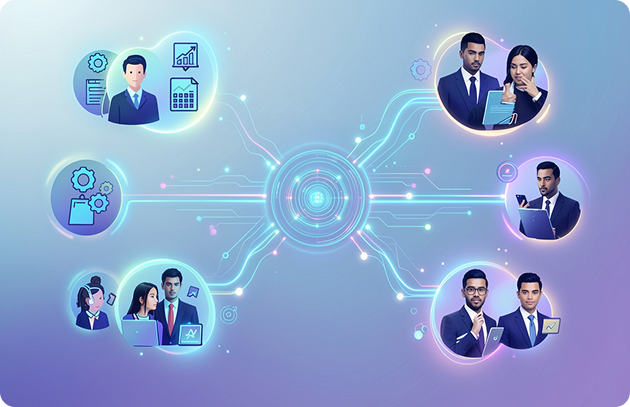
For years, enterprises relied on traditional automation tools to improve efficiency, reduce manual work, and streamline operations. From rule-based workflows and robotic process automation (RPA) to scripted chatbots and task schedulers, automation has helped businesses scale repetitive processes.
But in 2026, enterprise automation is entering a new phase.
Organizations are moving beyond static automation systems and adopting AI agents capable of:
Understanding context
Making decisions
Executing workflows dynamically
Communicating naturally
Coordinating across systems autonomously
This shift is transforming how enterprises think about automation itself.
The question businesses are now asking is no longer:
“How do we automate tasks?”
Instead, it’s:
“How do we build intelligent operational systems that can think and execute?”
That is the difference between traditional automation tools and modern AI agents.
What Are Traditional Automation Tools?
Traditional automation tools are systems designed to execute predefined tasks based on fixed rules and structured triggers.
Common examples include:
Robotic Process Automation (RPA)
Workflow automation platforms
Rule-based chatbots
Macros and scripting tools
Trigger-action systems
These tools operate well when:
✔ Workflows are predictable ✔ Inputs are structured ✔ Rules rarely change
However, they struggle when:
Conversations become dynamic Context changes Exceptions occur Human reasoning is required
Traditional automation is highly dependent on:
Predefined logic.
Unlike traditional automation, AI agents can:
✔ Understand natural language ✔ Reason through tasks dynamically ✔ Adapt to changing inputs ✔ Execute workflows autonomously ✔ Communicate conversationally through voice or chat
They function as:
Intelligent digital operators inside enterprise environments.
AI Agents vs Traditional Automation Tools: Key Differences
Capability
Traditional Automation
AI Agents
Workflow Logic
Rule-based
Dynamic reasoning
Communication
Limited / scripted
Natural conversational AI
Adaptability
Low
High
Context Awareness
Minimal
Advanced
Workflow Execution
Fixed tasks
Multi-step orchestration
Learning Capability
None
Context-driven improvement
Human-Like Interaction
Poor
Strong
Exception Handling
Weak
Flexible
Scalability
Process-limited
Operationally scalable
The core difference:
Traditional automation follows instructions. AI agents interpret goals and execute intelligently.
Why Traditional Automation Is Reaching Its Limits
Traditional enterprise automation tools were designed for environments where:
Workflows were repetitive
Inputs were structured
Business systems were simpler
Modern enterprise operations are now:
Multi-channel
Real-time
Highly dynamic
Data-heavy
Customer-centric
This creates challenges traditional automation tools struggle to solve.
Common Limitations of Traditional Automation
Static Workflow Dependency
Every process must be predefined manually.
Poor Handling of Exceptions
Unexpected inputs often break workflows.
Limited Conversational Capability
Scripted bots frustrate users quickly.
Heavy Maintenance Overhead
Rules require continuous updates.
Lack of Cross-System Intelligence
Automation tools typically operate in silos.
Why Enterprises Are Adopting AI Agents
1. AI Agents Can Understand Intent
Instead of relying on buttons or structured forms, AI agents interpret:
Enterprise Use Cases: Traditional Automation vs AI Agents
Healthcare
Traditional Automation:
Rule-based appointment reminders
Static patient workflows
AI Agents:
Conversational patient scheduling
Insurance verification
Follow-up coordination
Telehealth support
HIPAA-compliant AI voice agents are now becoming operational infrastructure in healthcare environments.
Hospitality
Traditional Automation:
Basic reservation systems
Scripted customer support bots
AI Agents:
Personalized guest engagement
AI-powered reservations
Dynamic order management
Loyalty automation
Auto Dealerships
Traditional Automation:
Email drip campaigns
Manual lead routing
AI Agents:
AI lead qualification
Test drive scheduling
Voice-based follow-ups
Real-time customer engagement
Real Estate
Traditional Automation:
CRM triggers
Static follow-up sequences
AI Agents:
Conversational lead nurturing
Property tour coordination
Buyer qualification
Dynamic follow-up automation
The Role of AI Agent Orchestration
One major reason AI agents outperform traditional automation is: AI orchestration
What Is AI Agent Orchestration?
AI orchestration coordinates:
LLM reasoning
Workflow logic
APIs and integrations
Memory systems
Execution pipelines
This allows AI agents to:
✔ Handle complex workflows ✔ Operate across systems ✔ Scale reliably ✔ Adapt dynamically in real time
Traditional automation lacks this intelligence layer.
Challenges Enterprises Must Consider
✔ Security & Compliance
Especially for regulated industries like healthcare and finance.
✔ Integration Complexity
AI agents must connect deeply with enterprise systems.
✔ Governance & Monitoring
Businesses need visibility into:
AI decisions
Workflow execution
Operational performance
✔ Enterprise Scalability
Production-grade AI systems must support:
High concurrency
Real-time processing
Multi-channel operations
This is why enterprises increasingly partner with specialized AI Agent Development Companies.
Why Virstack Helps Enterprises Move Beyond Traditional Automation
At Virstack, we help enterprises build:
AI agents with workflow automation
Enterprise AI voice agents
LLM-based operational systems
Conversational workflow platforms
AI orchestration infrastructure
Our AI systems are designed to:
✔ Execute workflows autonomously ✔ Integrate deeply with enterprise platforms ✔ Operate securely at scale ✔ Improve operational efficiency and customer engagement
We focus on building:
Intelligent operational infrastructure—not just automation scripts.
The Future of Enterprise Automation
The future enterprise will not rely solely on:
Rule-based automation Static workflows Scripted operational systems
Instead, enterprises will deploy:
✔ AI-powered operational agents ✔ Autonomous digital employees ✔ Conversational workflow systems ✔ Intelligent orchestration platforms
The shift from automation tools to AI agents is already underway.
Conclusion
Traditional automation tools helped enterprises digitize repetitive processes. AI agents are now helping enterprises operationalize intelligence itself.
The difference is clear:
Traditional automation follows rules.
AI agents understand, reason, and execute dynamically.
Businesses that adopt AI agents early will gain advantages in:
Scalability
Efficiency
Customer experience
Operational speed
Cost optimization
The next generation of enterprise operations will be powered by intelligent AI agents—not static automation systems.
Ready to Move Beyond Traditional Automation?
If your enterprise is exploring AI-powered workflow automation, AI voice agents, or intelligent operational systems, Virstack can help you build enterprise-grade AI solutions tailored to your workflows and business goals.
Schedule a free consultation with our AI experts and discover how AI agents can transform your enterprise operations in 2026 and beyond.